The 11th Society of Petroleum Engineers
Comparative Solution Project
11th SPE Comparative Solutions Project
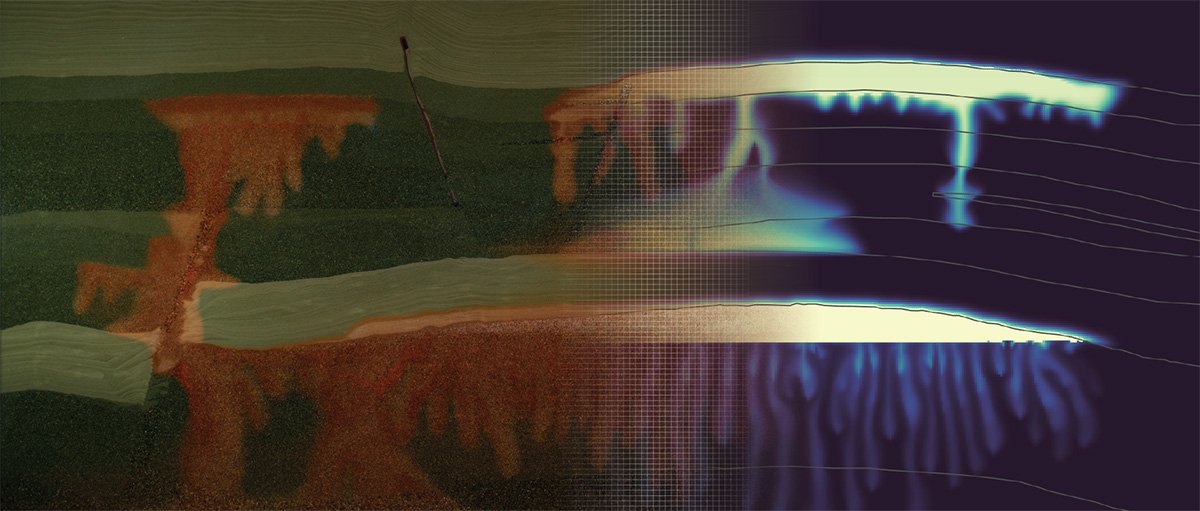
The 11th Society of Petroleum Engineers Comparative Solution Project (SPE11) benchmarked numerical simulation tools for geological carbon dioxide (CO₂) storage, running from 2023 to 2024. This international effort saw 45 research groups from academia and industry sign up, with 18 ultimately contributing results to the study. SPE11 represents a significant step in advancing simulation capabilities for CO₂ storage, a key technology for mitigating climate change.
Advancing CO₂ Storage Simulation
Building on decades of petroleum reservoir simulation research, CO₂ storage modeling leverages many of the same fundamental techniques, including multiphase flow modeling, numerical discretization, and reservoir-scale simulation frameworks. However, CO₂ storage also introduces unique challenges, such as well placement strategies, long-term storage security, and the balance of physical processes governing plume migration.
SPE11 was designed to assess how state-of-the-art reservoir simulators perform in modeling these complexities. By establishing a set of common benchmark cases and systematically comparing solutions, the project provided valuable insights into numerical accuracy, computational efficiency, and key uncertainties. As with previous SPE Comparative Solution Projects, the findings not only validated existing modeling approaches but also identified areas for future research and software development.
The results of SPE11 serve as a lasting reference for the subsurface modeling community, supporting the continued evolution of CO₂ storage simulation tools.
Benchmark Cases
SPE11 was designed around three distinct subcases, each targeting different aspects of CO₂ storage simulation:
- SPE11A – A controlled laboratory-scale experiment.
- SPE11B – A vertical 2D field-scale transect.
- SPE11C – A full 3D field-scale model.
These subcases share a common geometric framework, reducing the setup overhead for participants while exploring variations in physical scaling, pressure-temperature conditions, and computational challenges. Together, they provide a comprehensive testbed for assessing simulation accuracy and robustness.
Data and Online Resources
To maximize the impact of the study, all valid SPE11 submissions have been curated into a publicly accessible dataset, available through multiple resources:
- SPE11-at-a-glance – A dedicated webpage at spe.org provides a quick visual overview, including sparse-data plots, selected dense-data snapshots, and illustrative movies for each submission. This page is statically generated from an open-source script, ensuring reproducibility and potential future updates.
- Full SPE11 Dataset – The complete dataset, containing all submitted results, can be downloaded from DOI: 10.18419/DARUS-4750
- Interactive Online Access – All scripts for data analysis and visualization are available on GitHub, where users can explore the dataset, regenerate study figures, and even compare their own simulation results to the SPE11 benchmark using an integrated JupyterLab environment.
Please view the video below for visual introduction to case C of the 11th SPE CSP:
Explore the SPE 11C geometry further using in an interactive environment.
FURTHER INFORMATION
11th CSP Special Issue in SPE Journal
SPE Journal will be receiving peer-reviewed submissions that are both directly and indirectly related to the 11th CSP. More information can be found in the call for papers.
Project Results: The results from the 11th SPE CSP will be published in SPE Journal.
Participating Teams: A total of 18 teams delivered valid results.
SPE11-at-a-glance: Visual overview including animations and plots of submitted sparse and dense data.
Interactive Access: All scripts used for data analysis and visualization on GitHub, including functionality to explore and interact with the data, regenerate plots, include new data, etc.
Full SPE11 Dataset: Complete dataset with all submitted results available from 10.18419/DARUS-4750.
Benchmark Description: The official description of the 11th SPE CSP is available from SPE Journal.
Supplementary material such as geometry descriptions and scripts for thermodynamic relations: GitHub repository
Discussion Board: CSP group on SPEConnect
The CSP has been prepared and coordinated by Jan M. Nordbotten, University of Bergen; Martin Fernø, University of Bergen; Anthony R. Kovscek, Stanford University; Knut-Andreas Lie, SINTEF; and Bernd Flemisch, University of Stuttgart.
Note: Information from the 2001 Comparative Solutions Project and two Datasets can be found here.
View Visualizations of Submitted Results
